If you live with histamine intolerance, you already know that a "quick dinner out" is never actually quick. It's a mental spreadsheet of ingredients, prep methods, and worst-case scenarios. They’re all running in the background while you try to look relaxed and enjoy the company you're with. I get it, and you're not overreacting. Histamine intolerance is a real, physiologically documented condition in which the body can't break down dietary histamine fast enough, usually because of reduced activity of the enzyme diamine oxidase, or DAO, in the gut lining [1][3]. When histamine builds up faster than it can be cleared, you can end up with flushing, hives, headaches, digestive upset, a racing heart, or that unmistakable "something is wrong" feeling within minutes to a few hours of eating [2][10].
But, eating out with histamine intolerance doesn't have to mean a life of plain rice and steamed chicken breast. With a bit of cuisine knowledge, a short list of smart questions for your server, and a plan for supplemental DAO, dining out low histamine is genuinely doable. Let's walk through it the way I'd walk a patient or a friend through it.
Quick Refresher on Eating Out With Histamine Intolerance: Why Restaurant Food Is Riskier Than Home Cooking
At home, you control the ingredients, the storage time, and the cooking method, all of which affect histamine levels. Restaurant kitchens are a different story. Histamine accumulates in food as it ages, ferments, or sits, which is why the riskiest foods tend to be aged, cured, fermented, or leftover items rather than freshly prepared ones [1][4]. A sauce that's been simmering on the back burner for six hours, a "catch of the day" that's actually been on ice for four days, or a cheese plate built around anything aged, these are the categories that quietly sabotage a night out. Restaurants also love flavor-building techniques (long braises, stocks, reductions, marinades) that are essentially histamine-concentration machines.
This is why the goal when eating out with histamine intolerance isn't to avoid restaurants altogether. It's to choose cuisines and dishes built around freshness and simple preparation, and to ask the right questions when you're not sure.
Dining Out Low Histamine Cuisine-by-Cuisine: Safer Bets vs. High-Risk Territory
Generally safer: fresh, grilled, simply prepared cuisines
-
Fresh Mexican and Tex-Mex (the simple kind): Grilled meats, rice, and freshly made guacamole (made to order, not sitting in a bin) are usually well tolerated. Skip aged cheese, canned salsas, and anything with a long list of "house special sauce" ingredients.
-
Grilled Mediterranean and Greek: Freshly grilled fish, chicken skewers, and lamb, paired with rice or plain potatoes, tend to sit well. The catch is the olives, aged feta, wine, and marinated dishes that often surround them, so order selectively rather than avoiding the cuisine entirely.
-
Simple Vietnamese and Thai: Fresh herbs, rice noodles, and quickly grilled or steamed proteins are a nice fit. Fish sauce, shrimp paste, and chili pastes are fermented and can be problem ingredients, so ask for dishes without them or on the side.
-
American grill and steakhouse basics: A freshly grilled steak or chicken breast with a plain baked potato is about as low-risk as restaurant food gets, as long as the meat hasn't been dry-aged (dry-aging deliberately concentrates flavor through controlled bacterial and enzymatic activity, which also raises histamine).
Higher-risk: fermented, aged, and cured-heavy cuisines
-
Traditional Japanese, especially sushi and izakaya menus: This one surprises people. Fresh sashimi from fish that's been properly handled can be fine, but histamine rises quickly once fish starts to age, and it's genuinely hard to know how long that tuna has been sitting. Add soy sauce, miso, and pickled ginger, all fermented, and the histamine load in this cuisine adds up fast.
-
Italian, especially anything built on aged cheese, cured meat, or wine: Parmesan, prosciutto, salami, aged balsamic, and red wine are some of the most concentrated histamine sources on any menu [1][4]. A simple grilled fish or plain pasta with olive oil can still work; a charcuterie board or a rich, long-simmered ragu is asking for trouble.
-
Korean and heavily fermented East Asian cuisine: Kimchi, fermented soybean paste, and fermented fish sauces are dietary staples here, which makes this a genuinely difficult cuisine for HIT.
-
German and Central European: Sausages, sauerkraut, cured meats, and beer check almost every high-histamine box at once.
-
Indian (with nuance): Yogurt-based dishes and fermented items like dosa or idli batter can be higher in histamine, but a freshly grilled tandoori dish with rice is often a safer order from the same menu.
None of this means you're banned from these restaurants. But dining out low histamine means you need to be even more strategic about what you order once you're there.
What to Ask Your Server (Without Feeling Like a Burden) When You’re Dining Out and Need Low Histamine Options
Servers deal with allergies and intolerances constantly, and a few specific questions get you much further than a general "I have some food sensitivities":
- "Is this grilled or pan-seared fresh, or is it something that's been marinating or simmering for a while?"
- "Does this dish contain any aged cheese, cured meat, or fermented sauce, like soy sauce, fish sauce, or vinegar-based dressings?"
- "Can I get the sauce or dressing on the side?" This single request solves a huge percentage of hidden histamine exposure.
- "How fresh is the fish today?" A good server or kitchen will tell you honestly, and a vague answer is itself useful information.
- "Can this be made without wine, vinegar, or citrus marinade?" Wine and vinegar reductions are common flavor-building shortcuts that quietly raise histamine content.
If a restaurant seems irritated by these questions, that's data too. The kitchens that handle intolerances well tend to answer clearly and without a fuss.
Consider “Taking DAO Before You Go” When Eating Out With Histamine Intolerance
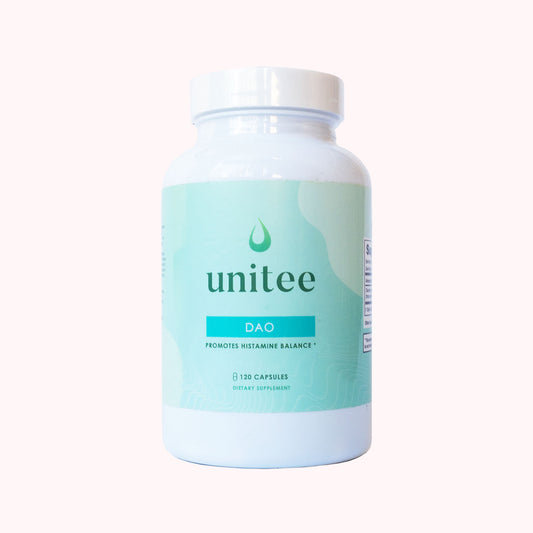
If you've talked to a doctor or dietitian about histamine intolerance, you've probably heard about DAO enzyme supplements, and there's a reasonable evidence base behind the "take it before you eat" strategy. Diamine oxidase is the enzyme primarily responsible for breaking down histamine in the gut, and when its activity is low, ingested histamine has an easier path into the bloodstream [3][6].
Several clinical studies have looked at taking supplemental DAO shortly before a meal. In one open-label pilot study, patients with confirmed histamine intolerance took DAO capsules before meals for four weeks. They reported significant improvement across a broad range of symptoms, including gastrointestinal, skin, and respiratory complaints, with symptoms creeping back once supplementation stopped [7]. A randomized, double-blind, placebo-controlled trial in migraine patients with documented DAO deficiency found that DAO supplementation before meals reduced both the frequency and duration of migraine attacks compared to placebo [9]. Earlier provocation studies using oral histamine challenges also support the idea that pre-treatment with DAO can blunt the body's reaction [8].
None of this means DAO is a free pass to order the charcuterie board and a glass of Cabernet. Think of it more like an umbrella: it reduces your risk and softens the impact if you are inadvertently exposed to a higher histamine meal. It just doesn't guarantee you'll stay perfectly dry in a downpour. I recommend people take it 15 to 30 minutes before eating for the best effect. If you're not already working with a healthcare provider on your histamine intolerance management, this is a good thing to bring up before starting any supplement routine.
Sit-Down vs. Takeout When Dining Out Low Histamine: Different Risks, Different Strategies
Sit-down restaurants give you the advantage of asking questions in real time and requesting modifications. Takeout removes that back-and-forth, but it also often means simpler menus. Think grilled chicken shops, poke-adjacent bowls with fresh ingredients, or build-your-own salad or burrito concepts where you can see exactly what's going into your food and can skip the fermented add-ons. Buffets and steam-table setups are usually the riskiest format overall, since food sits at length under heat, which is precisely the condition that allows histamine to climb.
Eating Out With Histamine Intolerance, the Final Thought
Eating out with histamine intolerance is a skill, not a life sentence. Once you know which cuisines lean toward fresh and grilled versus fermented and aged, and once you've got a short list of go-to questions and maybe a DAO supplement in your bag, you can walk into most restaurants with a real plan instead of a knot in your stomach. Give yourself grace on the nights it doesn't go perfectly. This is a learning process, and you'll get sharper at it with every meal out.
References
- Comas-Basté O, Sánchez-Pérez S, Veciana-Nogués MT, Latorre-Moratalla M, Vidal-Carou MDC. Histamine intolerance: the current state of the art. Biomolecules. 2020;10(8):1181.
- Schnedl WJ, Lackner S, Enko D, Schenk M, Holasek SJ, Mangge H. Evaluation of symptoms and symptom combinations in histamine intolerance. Intest Res. 2019;17(3):427-433.
- Alemany-Fornés M, Bori J, Muguerza B, Suárez M. Diamine oxidase deficiency implications for health, current management, and future directions in the treatment of histamine intolerance: A review. Int J Biol Macromol. 2025 Oct;327(Pt 1):147130.
- Manzotti G, Breda D, Di Gioacchino M, Burastero SE. Serum diamine oxidase activity in patients with histamine intolerance. Int J Immunopathol Pharmacol. 2016;29(1):105-111.
- Arih K, Đorđević N, Košnik M, Rijavec M. Evaluation of Serum Diamine Oxidase as a Diagnostic Test for Histamine Intolerance. Nutrients. 2023 Oct 2;15(19):4246.
- Kovacova-Hanuskova E, Buday T, Gavliakova S, Plevkova J. Histamine, histamine intoxication and intolerance. Allergol Immunopathol (Madr). 2015;43(5):498-506.
- Schnedl WJ, Schenk M, Lackner S, Enko D, Mangge H, Forster F. Diamine oxidase supplementation improves symptoms in patients with histamine intolerance. Food Sci Biotechnol. 2019;28(6):1779-1784.
- Komericki P, Klein G, Reider N, et al. Histamine intolerance: lack of reproducibility of single symptoms by oral provocation with histamine: a randomised, double-blind, placebo-controlled cross-over study. Wien Klin Wochenschr. 2011;123:15-20.
- Sánchez-Pérez S, Comas-Basté O, Duelo A, et al. Diamine oxidase supplement reduces headache in episodic migraine patients with DAO deficiency: a randomized double-blind trial. Clin Nutr. 2019;38(1):152-158.
-
Maintz L, Novak N. Histamine and histamine intolerance. Am J Clin Nutr. 2007;85(5):1185-1196.

Anita Tee
My name is Anita Tee. I'm a nutritional scientist specializing in histamine intolerance. I hold a Master of Science in Personalized Nutrition and a Bachelor of Science in Human Biology and Psychology.
For the past ten years, I have used my experience in nutritional and medical health sciences to create a scientifically backed, natural approach to healthcare that relies 100% on evidence-based research.
As I previously suffered from - and overcame - histamine intolerance, my focus is to increase recognition and expand the available resources and protocols for resolving the disorder. To date, I have helped over 4,000 individuals fully resolve or better manage their histamine intolerance symptoms.