You finish a hard run. Your skin lights up. Tiny red bumps pop across your chest and arms. Your face flushes. Your legs itch so badly you want to rip off your leggings.
Sound familiar? Maybe you typed “itchy after running” into a search bar at 9 p.m., hoping for answers. Well, you’re in the right place.
Here’s the good news. This is common, and it’s usually not dangerous. A well-described condition called cholinergic urticaria is behind many cases [1]. Even better, there are practical things you can do about it.
I’ll walk you through what’s happening in your body. I’ll show you how to tell a harmless reaction from a true allergy. Then we’ll build a pre-workout plan to keep your skin calm.
What Exercise Histamine Release Actually Is
Histamine is part of the exercise response
Histamine has a bad reputation. Most people connect it to hay fever and sneezing, but your body relies on it for many other jobs, including responding to exercise.
What the research shows:
-
One expert review describes histamine as a “molecular transducer of physical activity,” meaning it helps translate movement into biological signals [2].
-
The authors argue that the histamine released in working muscle is likely a basic part of how the body responds to exercise, not an allergic reaction [2].
-
Another human study of one-legged knee-extension exercise backs this up, finding that histamine left a broad footprint on the genes activated by exercise [3].
The takeaway? That’s a lot of biology for a molecule we mostly blame for runny noses and sneezing.
How histamine reaches your skin and blood vessels
After a workout, blood flow to the muscles you used stays high. Scientists call this sustained postexercise vasodilation. Histamine acting on H1 and H2 receptors drives much of it [4,5].
Histamine also acts on blood vessels and nerve endings near the skin. For most people, exercise histamine release goes completely unnoticed. For some, it tips from useful to annoying. That’s when you see flushing, bumps or itch.
Cholinergic Urticaria: The “Heat Hives” Most Gym-Goers Never Hear About
What it looks like
Cholinergic urticaria is a type of chronic inducible urticaria. That’s a technical way of saying hives with a trigger. The trigger here is a rise in body temperature and sweating [1].
The bumps are small. Think pinpoint, just a few millimeters wide, often ringed by red skin. They itch, sting or burn. They usually show up minutes into a workout and often fade within an hour or so once you cool down.
Hot showers, saunas, spicy food and emotional stress can set it off too. Exercise is simply the most common trigger for active people.
It often starts in the teens or twenties. Active people tend to notice it first, because they raise their body temperature on purpose several times a week. That is why so many gym-goers meet it before they ever hear its name.
Why heat and sweat set it off
Here’s the honest answer: scientists don’t fully agree. Several mechanisms seem to play a part. These include histamine, an allergy to your own sweat, blocked sweat pores and the chemical messenger acetylcholine [1].
That’s why one person’s hives after exercise look nothing like their training partner’s. The condition isn’t one-size-fits-all.
The subtypes that matter
Reviews now sort cholinergic urticaria into subtypes. These include poral occlusion, low sweating (hypohidrosis), sweat allergy and idiopathic cases with no clear cause [1].
Why should you care? Because the best treatment can differ by subtype [1]. A doctor who knows this can tailor your plan specifically to you, instead of guessing.
Hives After Exercise: Allergy or Normal Response?
Not every case of hives after exercise is cholinergic urticaria. Some are real allergic reactions. Telling them apart is the most important piece of information you’ll take away from this article.
Signs pointing to cholinergic urticaria
- Tiny, pinpoint bumps rather than big welts
- Symptoms that start as you warm up or sweat
- A repeat pattern with hot showers, saunas or stress
- Skin that settles within an hour or so of cooling down
- No trouble breathing, no dizziness, no stomach upset
Signs pointing to something more serious
Stop exercising and get help if you notice any of these:
- Large welts or swelling of the lips, eyelids or face
- Wheezing, a tight throat or a hoarse voice
- Dizziness, a sudden drop in energy or feeling faint
- Cramping, nausea or vomiting
These can signal anaphylaxis. If you carry epinephrine, use it as prescribed and call emergency services. Do not wait to see if it passes.
Exercise-induced and food-dependent reactions
Some people react only when exercise and a trigger food meet. Doctors call this food-dependent exercise-induced allergy. It goes like this: eat the food at rest, and you’re absolutely fine. Eat it and train, and you react.
A 2023 systematic review found these reactions come in three patterns: wheals, swelling, or anaphylaxis, alone or combined. The most common was anaphylaxis with wheals, swelling or both, seen in 80% of patients [6]. The review also lists augmenting factors that make reactions more likely [6]. Common amplifiers include aspirin, anti-inflammatory painkillers and alcohol.
If your reactions are bigger than tiny bumps, or they bring any whole-body symptoms, see an allergist. Don’t self-diagnose.
Itchy After Running: Why Legs and Arms Get Hit First
Blood flow, warmth and sensitive nerves
Feeling itchy after running is one of the most common complaints I hear from newer runners. It often starts in the legs. It can also show up in the arms or hands.
Running opens up tiny blood vessels to feed working muscle. Nerve endings in the skin can read that surge as itch. Since histamine helps drive that vasodilation [4,5], it’s reasonable to think it plays a role. Researchers haven’t pinned down how big that role is.
Here’s a useful rule of thumb. A mild, crawling itch that fades quickly with no visible bumps is common and usually benign. Raised bumps or a rash deserve a closer look.
Everyday extras that stack on top
Dry skin makes itch worse. So do tight, sweaty fabrics, harsh laundry detergent and cold, dry air. A very hot shower right after your run adds more heat to an already warm body. Small fixes here can make a real difference.
Still itchy after running even with those fixes? Look at the pattern.
Does it happen only in the heat? Only on long runs? Only after certain meals?
Those clues point you toward the right trigger, and they give your doctor something concrete to work with.
Exercise and Itching: Is This Histamine Intolerance?
Many people with this exact symptom have never heard the term “histamine intolerance.” It matters because it might explain why your reactions come and go.
The term describes a range of symptoms after eating histamine-rich food [7]. It is usually blamed on low activity of diamine oxidase, or DAO, an enzyme that breaks down histamine in the gut [8].
The bucket idea
Picture a bucket. Histamine from food, wine, stress, heat and exercise all pours in. Most days it never overflows. On a hot day, after a big meal of aged cheese and red wine, one more workout tips it over.
It’s a handy way to think about why the same workout is fine on Tuesday and itchy on Saturday. It also means exercise histamine release may not be the only thing filling the bucket.
Where DAO fits
DAO works in your gut. It targets histamine from the food you eat, before it reaches your bloodstream. It is not designed to block the histamine your muscles and skin release during a workout. Keep that distinction in mind.
What does the evidence say? In a randomized crossover trial, DAO capsules reduced histamine-associated symptoms compared with placebo [7]. In a trial of 100 migraine patients with DAO deficiency, one month of DAO showed a positive trend, but the authors called for longer studies [8]. I could not find trials testing DAO for exercise-triggered symptoms.
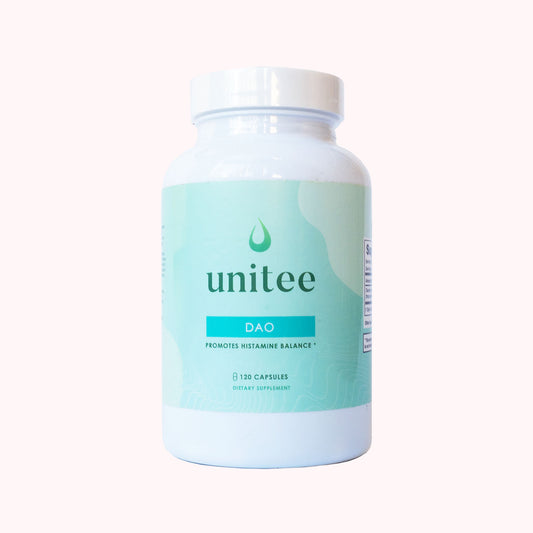
So treat DAO as a reasonable experiment, not a cure. If you want to try one, you can explore the use of a DAO supplement to see if it generally helps to lower the amount of histamine in your bucket to reduce exercise-induced flares.
Practical Pre-Workout Strategies for Exercise Histamine Release
Warm up in stages
A fast jump in core temperature is a classic trigger. Start easy for 10 minutes. Let your body heat rise slowly. Train in a cooler room or near a fan when you can and keep your water close.
Mind your meal timing
Skip alcohol before training. Avoid aspirin or ibuprofen right before a session unless a doctor told you to take them. If you already know a food triggers you, don’t eat it for several hours before exercise. If you see an allergist regarding food sensitivities, follow their advice on timing.
Choose a lower-histamine pre-workout meal
Histamine builds up in aged, cured, fermented and leftover foods. Fresh is safer. Think oats with a banana, fresh-cooked chicken with rice, or plain yogurt with fresh fruit. Keep it simple and eat it two to three hours before you train.
Consider DAO with your meal
Some people take a DAO capsule before a pre-workout meal to help manage excess histamine. Follow the label and take it with food, since it works in the gut. Track how you feel for a few weeks. If nothing changes and you still experience flares, you’re likely looking at other sources of histamine that are not gut derived.
Ask a pharmacist about antihistamines
Non-sedating antihistamines are the standard starting point for hives. Ask your doctor or pharmacist whether to take one before training.
Here’s the nuance. In a small study, healthy adults took a single high dose of two antihistamines before downhill running. The dose of fexofenadine was well above typical label doses, but it showed muscle damage markers rose, yet strength loss and soreness dropped [9]. It’s one study with 12 people per group so treat it as a reason to ask questions, not a reason to stop your medication.
Pick your time and place
Heat is the common thread. In summer, train early or late, or move your session indoors. Dress in light layers you can peel off. If you notice the first tingle, slow down and let your body cool before you push on. Many people find that catching it early keeps a mild flush from becoming full hives.
Cool down and rinse off
Take a cool, not hot, shower soon after you finish. Sweat left on the skin may bother people with the sweat allergy subtype [1]. Wear breathable fabrics, pat yourself dry instead of rubbing, and remember to moisturize.
Keep a symptom log
For two weeks, write down the workout, the temperature, what you ate, any alcohol or painkillers, your stress and your sleep. Patterns show up fast. Bring the log to your doctor's appointment, they love this kind of stuff.
When To See a Doctor About Exercise Histamine Release
Book an appointment if reactions happen often, spread beyond small bumps, or stop you from training. An allergist can test for triggers and may suggest a supervised exercise challenge. They can also identify your subtype, which guides treatment [1].
Go straight to emergency care for breathing trouble, throat tightness, facial swelling or fainting. No workout is worth the risk of a full blown anaphylactic episode.
Histamine Intolerance and Exercise: The Bottom Line
Your skin is not betraying you. Exercise histamine release is a normal part of how bodies respond to training [2], and unfortunately, in some people it spills over into flushing, itch and tiny hives.
Learn the pattern. Rule out the red flags. Then test one change at a time: a slower warm-up, a lower-histamine meal, a cooler shower, maybe a DAO supplement. Small tweaks really add up and give you more clues as to what could be going on.
If hives after exercise keep showing up, get a proper workup. You deserve a plan that keeps you training, comfortably and safely.
And if you’re one of the many people who feel itchy after running, take heart. You now know the likely culprits, the red flags and the first things to try. That puts you ahead of most people on the starting line.
References:
- Fukunaga A, Washio K, Hatakeyama M, Oda Y, Ogura K, Horikawa T, Nishigori C. Cholinergic urticaria: epidemiology, physiopathology, new categorization, and management. Clin Auton Res. 2018 Feb;28(1):103-113.
- Luttrell MJ, Halliwill JR. The Intriguing Role of Histamine in Exercise Responses. Exerc Sport Sci Rev. 2017 Jan;45(1):16-23.
- Romero SA, Hocker AD, Mangum JE, Luttrell MJ, Turnbull DW, Struck AJ, Ely MR, Sieck DC, Dreyer HC, Halliwill JR. Evidence of a broad histamine footprint on the human exercise transcriptome. J Physiol. 2016 Sep 1;594(17):5009-23.
- McCord JL, Halliwill JR. H1 and H2 receptors mediate postexercise hyperemia in sedentary and endurance exercise-trained men and women. J Appl Physiol (1985). 2006 Dec;101(6):1693-701.
- Halliwill JR, Buck TM, Lacewell AN, Romero SA. Postexercise hypotension and sustained postexercise vasodilatation: what happens after we exercise? Exp Physiol. 2013 Jan;98(1):7-18.
- Kulthanan K, Ungprasert P, Jirapongsananuruk O, Rujitharanawong C, Munprom K, Trakanwittayarak S, Pochanapan O, Panjapakkul W, Maurer M. Food-Dependent Exercise-Induced Wheals/Angioedema, Anaphylaxis, or Both: A Systematic Review of Phenotypes. J Allergy Clin Immunol Pract. 2023 Jun;11(6):1926-1933.
- Komericki P, Klein G, Reider N, Hawranek T, Strimitzer T, Lang R, Kranzelbinder B, Aberer W. Histamine intolerance: lack of reproducibility of single symptoms by oral provocation with histamine: a randomised, double-blind, placebo-controlled cross-over study. Wien Klin Wochenschr. 2011 Jan;123(1-2):15-20.
- Izquierdo-Casas J, Comas-Basté O, Latorre-Moratalla ML, Lorente-Gascón M, Duelo A, Soler-Singla L, Vidal-Carou MC. Diamine oxidase (DAO) supplement reduces headache in episodic migraine patients with DAO deficiency: A randomized double-blind trial. Clin Nutr. 2019 Feb;38(1):152-158.
-
Ely MR, Romero SA, Sieck DC, Mangum JE, Luttrell MJ, Halliwill JR. A single dose of histamine-receptor antagonists before downhill running alters markers of muscle damage and delayed-onset muscle soreness. J Appl Physiol (1985). 2017 Mar 1;122(3):631-641.

Anita Tee
My name is Anita Tee. I'm a nutritional scientist specializing in histamine intolerance. I hold a Master of Science in Personalized Nutrition and a Bachelor of Science in Human Biology and Psychology.
For the past ten years, I have used my experience in nutritional and medical health sciences to create a scientifically backed, natural approach to healthcare that relies 100% on evidence-based research.
As I previously suffered from - and overcame - histamine intolerance, my focus is to increase recognition and expand the available resources and protocols for resolving the disorder. To date, I have helped over 4,000 individuals fully resolve or better manage their histamine intolerance symptoms.